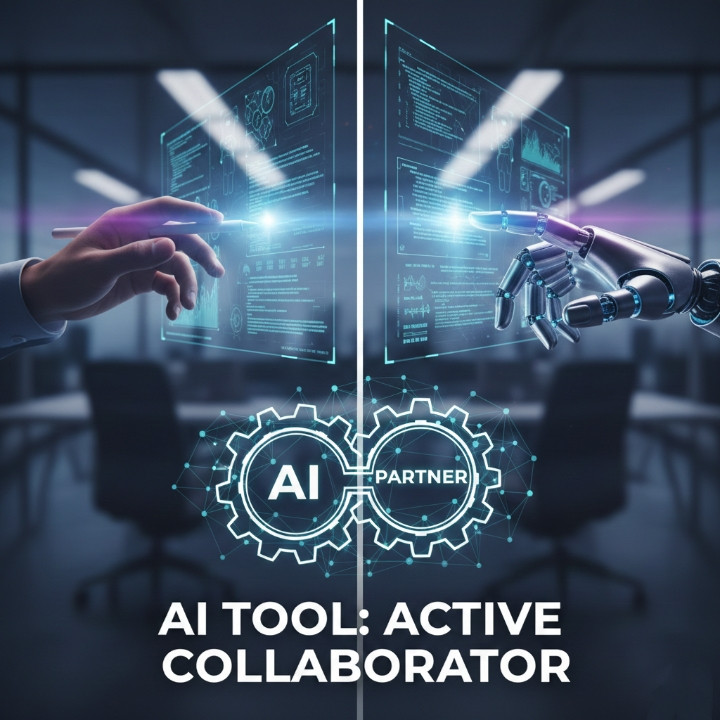
In the early 2020s, technology was a passive instrument—a "sophisticated hammer" that required a human hand to strike. But as we step into 2026, the paradigm has shifted. The evolution of artificial intelligence (AI) from a tool into an active, collaborative partner 2026 marks the most significant change in professional history. We are no longer just operating software; we are collaborating with digital entities that possess intent, memory, and agency.
By 2026, the "chatbot" is dead. In its place is the AI Agent—a partner that understands project goals, anticipates obstacles, and works alongside you in real-time. This shift is redefining the very fabric of how we create, manage, and scale businesses globally.

The visualization of Agentic AI acting as a neural partner to human strategy.
Why 2026 is the Year of the AI Partner
The transformation of artificial intelligence (AI) from a tool into an active, collaborative partner 2026 is driven by "Agentic Workflows." Unlike traditional AI, which waits for a prompt, these agents are goal-oriented. You provide a destination, and the AI plans the journey.
Autonomous Execution and Reasoning
An AI partner today can manage multi-step processes. If you tell your partner to "prepare the quarterly board deck," it doesn't just draft slides. It accesses the latest financial data, identifies key trends, generates visualizations, and even drafts a list of potential questions the board might ask. It acts with the autonomy of a senior associate.
Contextual Memory: The Teammate That Knows You
Collaborative AI in 2026 features "Long-Term Context." It remembers your preferences, your previous feedback, and the specific nuances of your brand voice. This means you don't have to start from scratch with every task; your partner learns and evolves with you.
Industry Shifts: Collaboration in Action

Human-AI synergy: Bridging the gap between data and intuition.
Software Development: The Co-Architect
For developers, AI has moved from a code-completer to a system architect. It monitors the entire codebase, identifying potential security leaks before they happen and suggesting structural optimizations during the design phase, not just after the code is written.
Marketing: Real-Time Strategy Partners
Marketers now use AI partners to run thousands of A/B tests simultaneously. The AI detects which creative direction is winning and automatically re-allocates budgets, allowing humans to focus purely on the high-level brand narrative.
The Economic Impact: Tool vs. Partner
The difference between viewing AI as a tool versus a partner is now visible in the balance sheets of global enterprises.
| Workflow Feature | Legacy Tool (2024) | Collaborative Partner (2026) |
|---|---|---|
| Decision Making | Human-led only. | Shared (AI suggests, Human decides). |
| Operational Speed | Limited by human input. | Limited only by processing power. |
| Integration | Standalone apps. | Deeply integrated Agentic Ecosystems. |
The Challenges of Digital Partnership
As artificial intelligence (AI) from a tool into an active, collaborative partner 2026 becomes reality, new challenges emerge. Security is no longer just about data protection; it's about "Agency Governance." Organizations must ensure that their AI partners operate within ethical boundaries and that their decision-making logic remains transparent (Explainable AI).
Conclusion: Embracing Co-Intelligence
The transition of artificial intelligence (AI) from a tool into an active, collaborative partner 2026 represents a move toward "Co-Intelligence." We are entering a future where our success depends on our ability to mentor, direct, and collaborate with digital minds. This partnership doesn't replace human ingenuity—it amplifies it to a scale previously thought impossible.
Is Your Business Ready for an AI Partner?
The era of passive tools is over. Start building your collaborative AI strategy today to lead your industry in 2026.